【 使用环境 】 测试环境
【 OB or 其他组件 】opproxy && opserver
【 使用版本 】 4.3.1
【问题描述】
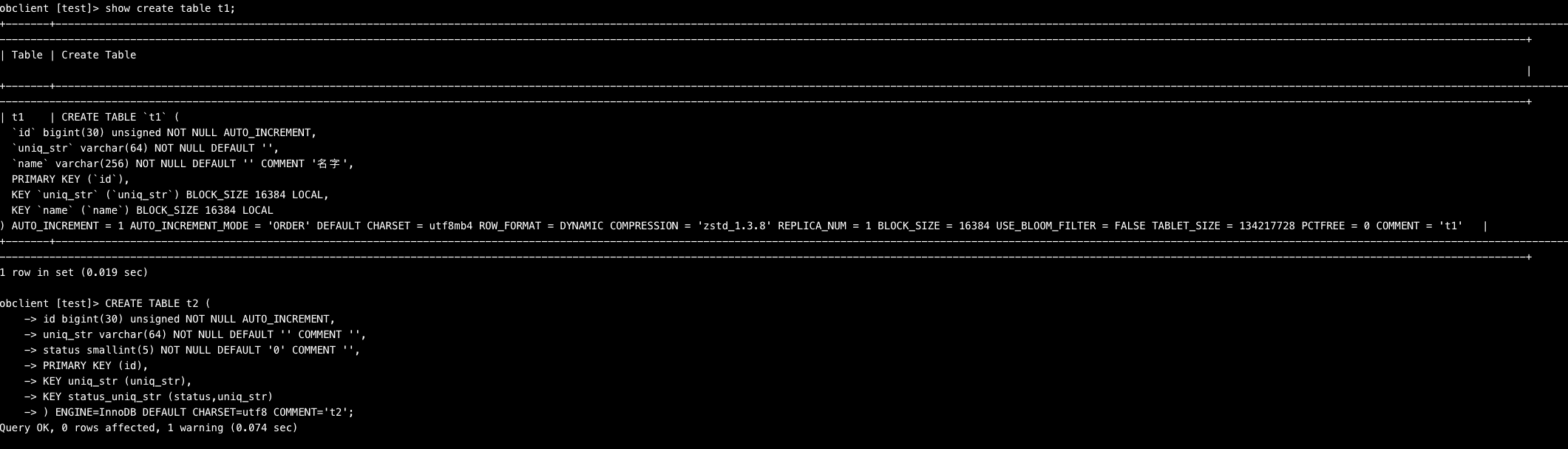
建表语句:
CREATE TABLE t1 (
id bigint(30) unsigned NOT NULL AUTO_INCREMENT,
uniq_str varchar(64) NOT NULL DEFAULT ‘’ COMMENT ‘’,
name varchar(256) NOT NULL DEFAULT ‘’ COMMENT ‘名字’,
PRIMARY KEY (id),
KEY uniq_str (uniq_str),
KEY name (name)
) ENGINE=InnoDB DEFAULT CHARSET=utf8 COMMENT=‘t1’;
CREATE TABLE t2 (
id bigint(30) unsigned NOT NULL AUTO_INCREMENT,
uniq_str varchar(64) NOT NULL DEFAULT ‘’ COMMENT ‘’,
status smallint(5) NOT NULL DEFAULT ‘0’ COMMENT ‘’,
PRIMARY KEY (id),
KEY uniq_str (uniq_str),
KEY status_uniq_str (status,uniq_str)
) ENGINE=InnoDB DEFAULT CHARSET=utf8 COMMENT=‘t2’;
执行SQL:explain SELECT /*+ PARALLEL(10) */ name, count(t1.uniq_str) as num FROM t1 LEFT JOIN t2 ON t2.uniq_str = t1.uniq_str WHERE t2.status IN(0, 1) GROUP BY t1.name LIMIT 10;
OBPROXY 返回结果:
explain SELECT /*+ PARALLEL(10) */ name, count(t1.uniq_str) as num FROM t1 LEFT JOIN t2 ON t2.uniq_str = t1.uniq_str WHERE t2.status IN(0, 1) GROUP BY t1.name LIMIT 10;
±--------------------------------------------------------------------------------------------------------------+
| Query Plan |
±--------------------------------------------------------------------------------------------------------------+
| ========================================================================= |
| |ID|OPERATOR |NAME |EST.ROWS|EST.TIME(us)| |
| ------------------------------------------------------------------------- |
| |0 |LIMIT | |1 |10 | |
| |1 |±HASH GROUP BY | |1 |10 | |
| |2 | ±HASH JOIN | |1 |9 | |
| |3 | |-PX COORDINATOR | |1 |7 | |
| |4 | | ±EXCHANGE OUT DISTR|:EX10000 |1 |6 | |
| |5 | | ±TABLE RANGE SCAN|t2(status_uniq_str)|1 |5 | |
| |6 | ±TABLE FULL SCAN |t1 |1 |3 | |
| ========================================================================= |
| Outputs & filters: |
|---|
| 0 - output([t1.name], [T_FUN_COUNT(t1.uniq_str)]), filter(nil), rowset=16 |
| limit(10), offset(nil) |
| 1 - output([t1.name], [T_FUN_COUNT(t1.uniq_str)]), filter(nil), rowset=16 |
| group([t1.name]), agg_func([T_FUN_COUNT(t1.uniq_str)]) |
| 2 - output([t1.name], [t1.uniq_str]), filter(nil), rowset=16 |
| equal_conds([t2.uniq_str = t1.uniq_str]), other_conds(nil) |
| 3 - output([t2.uniq_str]), filter(nil), rowset=16 |
| 4 - output([t2.uniq_str]), filter(nil), rowset=16 |
| is_single, dop=1 |
| 5 - output([t2.uniq_str]), filter(nil), rowset=16 |
| access([t2.uniq_str]), partitions(p0) |
| is_index_back=false, is_global_index=false, |
| range_key([t2.status], [t2.uniq_str], [t2.id]), range(0,MIN,MIN ; 0,MAX,MAX), (1,MIN,MIN ; 1,MAX,MAX), |
| range_cond([t2.status IN (0, 1)]) |
| 6 - output([t1.uniq_str], [t1.name]), filter(nil), rowset=16 |
| access([t1.uniq_str], [t1.name]), partitions(p0) |
| is_index_back=false, is_global_index=false, |
| range_key([t1.id]), range(MIN ; MAX)always true |
±--------------------------------------------------------------------------------------------------------------+
31 rows in set (0.01 sec)
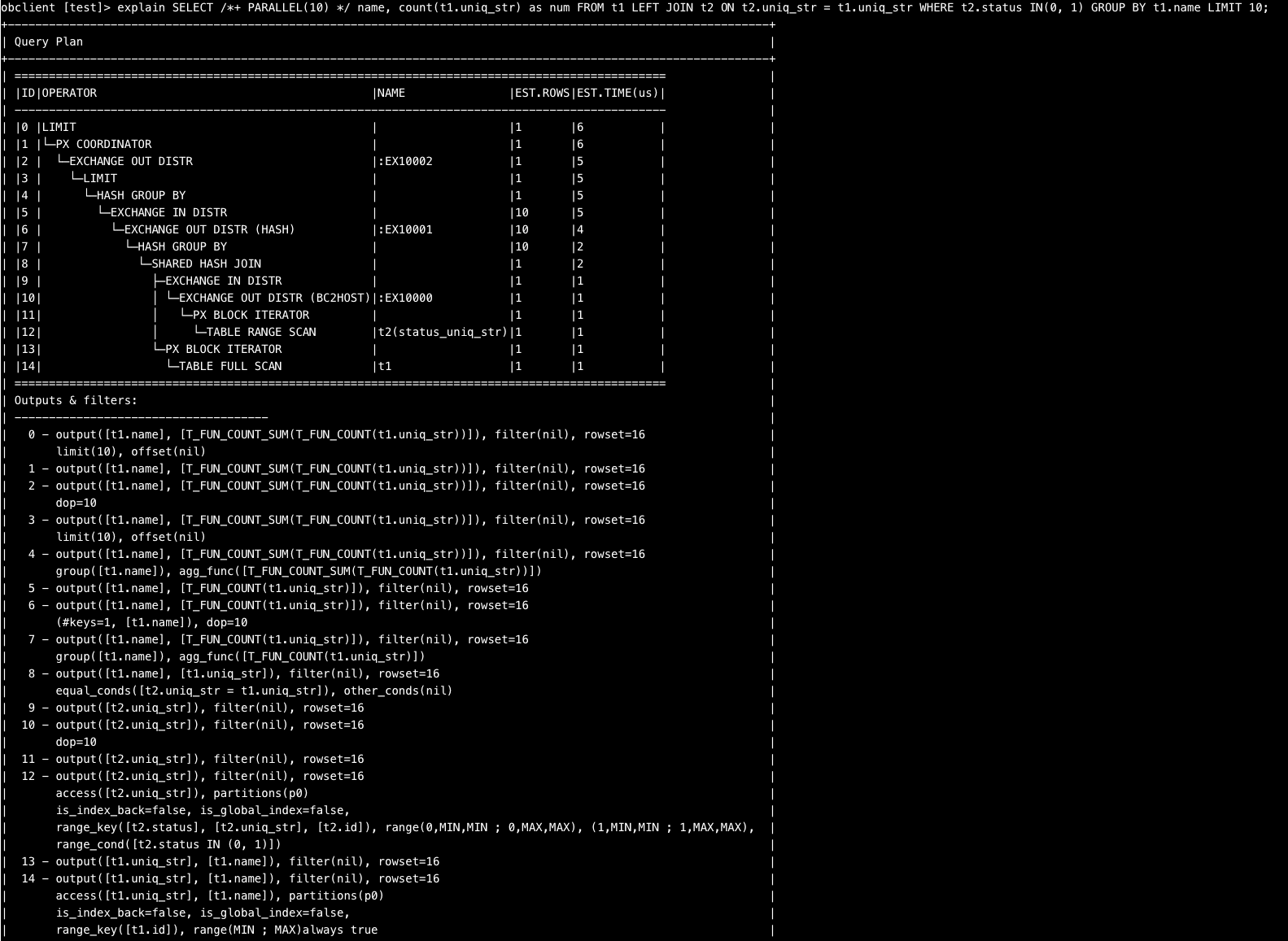
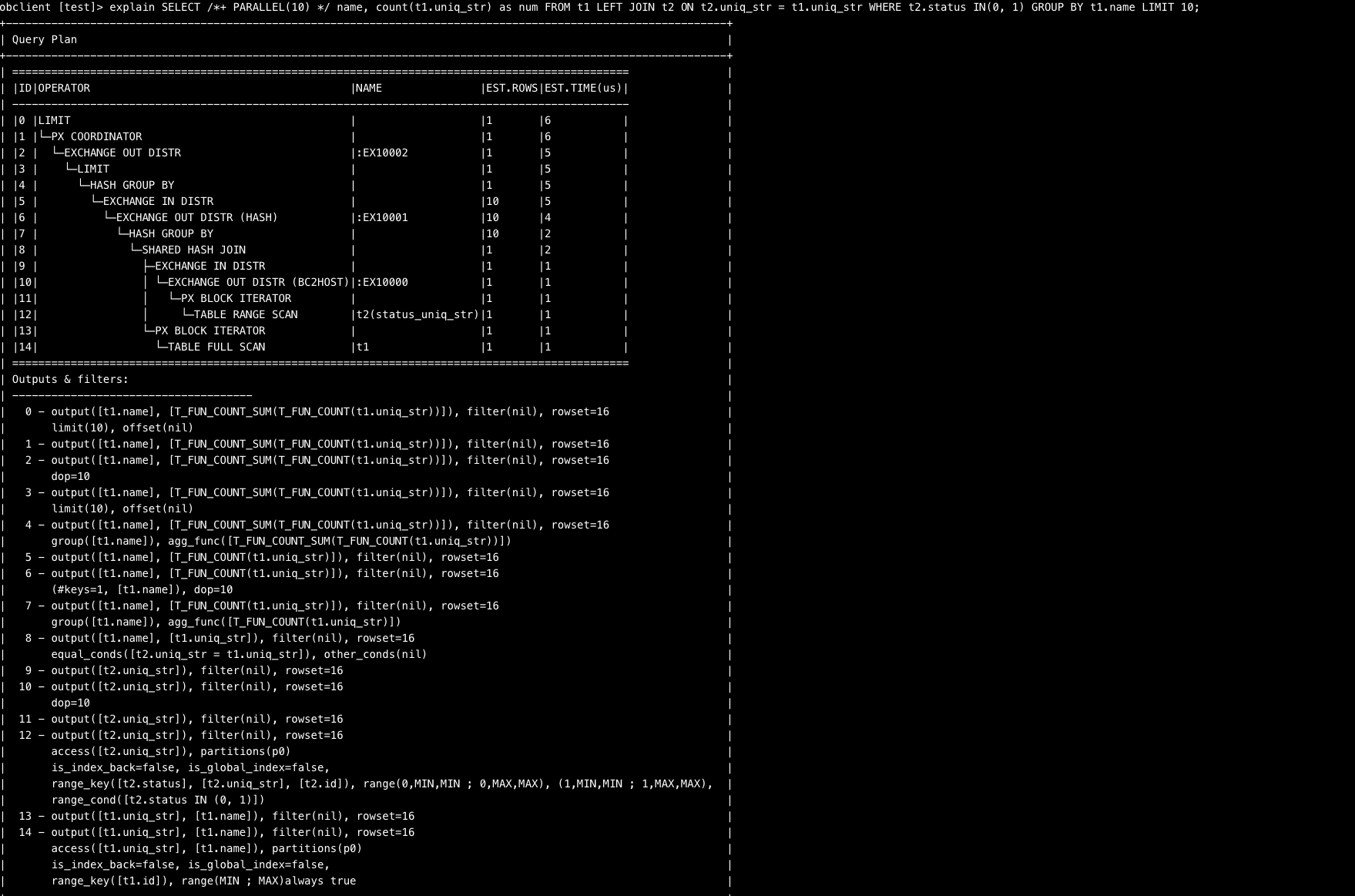
OBSERVER 返回结果:
explain SELECT /*+ PARALLEL(10) */ name, count(t1.uniq_str) as num FROM t1 LEFT JOIN t2 ON t2.uniq_str = t1.uniq_str WHERE t2.status IN(0, 1) GROUP BY t1.name LIMIT 10;
±--------------------------------------------------------------------------------------------------------------+
| Query Plan |
±--------------------------------------------------------------------------------------------------------------+
| =============================================================================================== |
| |ID|OPERATOR |NAME |EST.ROWS|EST.TIME(us)| |
| ----------------------------------------------------------------------------------------------- |
| |0 |LIMIT | |1 |3 | |
| |1 |└─PX COORDINATOR | |1 |3 | |
| |2 | └─EXCHANGE OUT DISTR |:EX10002 |1 |2 | |
| |3 | └─LIMIT | |1 |2 | |
| |4 | └─HASH GROUP BY | |1 |2 | |
| |5 | └─EXCHANGE IN DISTR | |1 |2 | |
| |6 | └─EXCHANGE OUT DISTR (HASH) |:EX10001 |1 |2 | |
| |7 | └─HASH GROUP BY | |1 |2 | |
| |8 | └─SHARED HASH JOIN | |1 |1 | |
| |9 | ├─EXCHANGE IN DISTR | |1 |1 | |
| |10| │ └─EXCHANGE OUT DISTR (BC2HOST)|:EX10000 |1 |1 | |
| |11| │ └─PX BLOCK ITERATOR | |1 |1 | |
| |12| │ └─TABLE RANGE SCAN |t2(status_uniq_str)|1 |1 | |
| |13| └─PX BLOCK ITERATOR | |1 |1 | |
| |14| └─TABLE FULL SCAN |t1 |1 |1 | |
| =============================================================================================== |
| Outputs & filters: |
|---|
| 0 - output([t1.name], [T_FUN_COUNT_SUM(T_FUN_COUNT(t1.uniq_str))]), filter(nil), rowset=16 |
| limit(10), offset(nil) |
| 1 - output([t1.name], [T_FUN_COUNT_SUM(T_FUN_COUNT(t1.uniq_str))]), filter(nil), rowset=16 |
| 2 - output([t1.name], [T_FUN_COUNT_SUM(T_FUN_COUNT(t1.uniq_str))]), filter(nil), rowset=16 |
| dop=10 |
| 3 - output([t1.name], [T_FUN_COUNT_SUM(T_FUN_COUNT(t1.uniq_str))]), filter(nil), rowset=16 |
| limit(10), offset(nil) |
| 4 - output([t1.name], [T_FUN_COUNT_SUM(T_FUN_COUNT(t1.uniq_str))]), filter(nil), rowset=16 |
| group([t1.name]), agg_func([T_FUN_COUNT_SUM(T_FUN_COUNT(t1.uniq_str))]) |
| 5 - output([t1.name], [T_FUN_COUNT(t1.uniq_str)]), filter(nil), rowset=16 |
| 6 - output([t1.name], [T_FUN_COUNT(t1.uniq_str)]), filter(nil), rowset=16 |
| (#keys=1, [t1.name]), dop=10 |
| 7 - output([t1.name], [T_FUN_COUNT(t1.uniq_str)]), filter(nil), rowset=16 |
| group([t1.name]), agg_func([T_FUN_COUNT(t1.uniq_str)]) |
| 8 - output([t1.name], [t1.uniq_str]), filter(nil), rowset=16 |
| equal_conds([t2.uniq_str = t1.uniq_str]), other_conds(nil) |
| 9 - output([t2.uniq_str]), filter(nil), rowset=16 |
| 10 - output([t2.uniq_str]), filter(nil), rowset=16 |
| dop=10 |
| 11 - output([t2.uniq_str]), filter(nil), rowset=16 |
| 12 - output([t2.uniq_str]), filter(nil), rowset=16 |
| access([t2.uniq_str]), partitions(p0) |
| is_index_back=false, is_global_index=false, |
| range_key([t2.status], [t2.uniq_str], [t2.id]), range(0,MIN,MIN ; 0,MAX,MAX), (1,MIN,MIN ; 1,MAX,MAX), |
| range_cond([t2.status IN (0, 1)]) |
| 13 - output([t1.uniq_str], [t1.name]), filter(nil), rowset=16 |
| 14 - output([t1.uniq_str], [t1.name]), filter(nil), rowset=16 |
| access([t1.uniq_str], [t1.name]), partitions(p0) |
| is_index_back=false, is_global_index=false, |
| range_key([t1.id]), range(MIN ; MAX)always true |
±--------------------------------------------------------------------------------------------------------------+
51 rows in set (0.027 sec)